
Magic Capital
Welcome to Joy Giving
When I was a kid growing up outside Portland, I had three jars of money in my bedroom closet: Give, Save, Spend.

Each week, I received my “allowance” of precisely $1 from my parents. Three quarters, one nickel, and two dimes. The first four coins went in the “spend” jar – eighty cents. Dime #1 was for the “save” jar. And Dime #2 was for “give.”
Give, Save, Spend. My financial life has become more complicated, but there are still just three uses for money: Give, Save, Spend.
Give: money to share,
Save: money to invest,
Spend: money to live on.
In describing our Adversary, Jesus says, “The enemy comes to steal, kill and destroy.”
Think about it.
Stealing is the opposite of... giving.
Destroying is the opposite of... saving (building or investing).
Killing is the opposite of... living (the amounts we “live on” through spending).
God cares about all three jars in your life. Not just the Give jar.
Spend: He invites you to live and enjoy what He’s given you, to celebrate life with feasts and to care for those you love.
Save: He welcomes us to invest, to grow. In Jesus’ day, people invested by building homes and planting crops, and received a return at the harvest.
Give: He places wealth in our hands not just for our own consumption, but to bless others.
While all three jars can be good, we have different “hurdle rates” for each jar — all of us expect each jar to bring different kinds of returns. I argue that charitable capital is magic capital — that the ways we caretake it are wildly important.
Here’s why:
When we use the “save” jar, we expect a financial return. Perhaps you aim for 8% or 10%. Whatever your hurdle rate, you expect some financial return.
When we use the “spend” jar, we expect equivalent value. You spend $100 to get $100 of groceries, or you spend $50,000 to get a car worth $50,000. Sometimes we overpay by a bit, or get a great deal and underpay, but generally what we get is equivalent in value.
And then there’s magic capital.
When we give money away, we get a guaranteed financial return of negative 100%. Every time. Why do we do it?
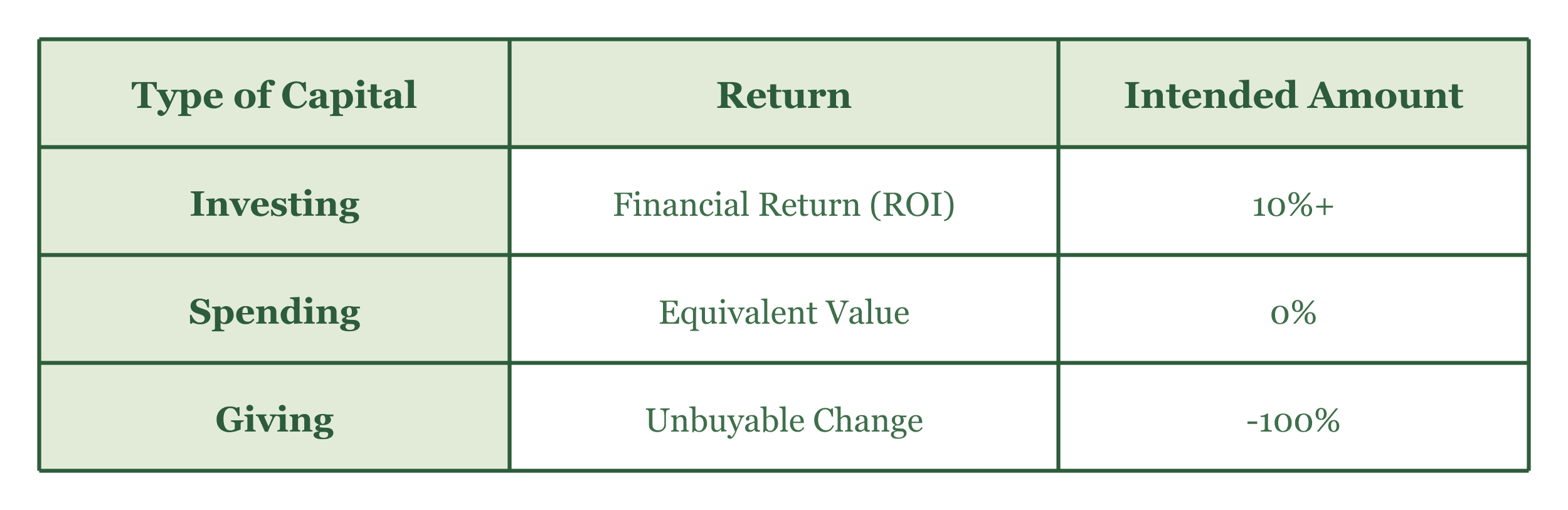
We give because there’s something we hope to see happen in the world that we can’t buy directly with money.
I want to see orphans adopted, but my home is already full, so I give to an orphanage.
I want to see people in Bangladesh have the chance to know the joy of Jesus, but I can’t go there, don’t know the people, and don’t speak the language. So I give so that others can.
I want children to receive beautiful Christian education, but I’m not an educator and am busy with other things, so I give to a school that’s better equipped than I.

Giving capital is magic since its returns are measured in a different denominator.
And I don’t expect “ROI” or “equivalent value” from any of them. The returns are measured in a different currency. Asking charity for a financial return is what’s called a “category error,” like asking “what color Thursday is.”
Since it requires no financial return, charitable capital can be used to do anything. Its denominator — its currency — can be lives saved, wells drilled, slaves freed.
But we often pay the least attention to this category. Since we aren’t sure how to denominate it, we assume that if it’s “doing good,” then that’s good enough.
We are deceived. Caretaking the most precious kind of capital requires the most thoughtful discernment.
We don’t invest without some due diligence. On M&A deals alone, we spend nearly $9b annually doing due diligence. We want to ensure that we’ve mitigated risks, identified opportunities, and will get great ROI.
Even in spending, we shop around for the best car, the right home, and discern the right college for our kids to attend.

For most key purchases, we think deeply and research widely. Why not give more focus on our giving?
Why? Because we have a sense that returns matter. We want our investments to generate profit. We want our spend wisely. But when it comes to the magic capital -- the capital that requires no return -- we give aimlessly.
And almost all of them share the same secret:
They have no idea if their giving is actually working. Giving doesn’t bring joy.
They are tired of aimless giving. They are looking for the outrageous joy that becomes available when we start deploying wealth the way God designed.
Through Candle, my firm, I have spent years sitting across the table from some of the most thoughtful, high-capacity givers in the world. Our motto is “joyful givers, vibrant ministries.” We aim for high-yield giving. Giving that yields great fruit in this life and the next.
Over the years, we’ve identified a “joy genome.” It’s like giving has DNA, and a genetic code. And if we can understand how it works, the Spirit of Jesus seems to unlock great joy.
In the posts that follow, we’ll get into the specific, but here’s the preview:
Faithful
Fruitful
Focused
Friends

When we give to, and through, faithful fruitful friends, there’s a path to joy.
Faithful — Are they theologically and financially trustworthy?
Fruitful — When we invest seed, does the ministry bear fruit? How do we know?
Friends — Are the leaders and team loving? People give to people. We delight when giving to, and through, those who genuinely love us, and genuinely love those they serve.

Does it mean every gift works? No way. But when we map givers’ most joyful and effective gifts, these are the elements that show up nearly every time.
I am going to ask the hard questions that wealth managers and ministry fundraisers are too polite to bring up:
Whose money is it, anyway?
What are you afraid of?
Why does giving feel like a chore?
How many ministries can your family actually know and love?
Why do we celebrate the expense line (how much we gave) instead of the return (how the world changed as a result of our gift)?
To start the journey with us and hear stories of those who give with wisdom and joy — along with those who openly share their regrets — subscribe below. Our first deep-dive essay drops next week: "No One Sets Out to Waste It."