
No One Sets Out to Waste It
What is Wealth For? - Week 1
Jerry and Kathy live in Minneapolis and have two grown children. When the kids were young, Jerry started a brilliant business that digitized legal records. After selling the company for more than $100 million, Jerry realized he wasn’t just a good businessman–he was also a highly talented investor.
Jerry and Kathy wanted to look out for their kids, so they generously set aside $2 million in a trust for each of them. “We wanted to ensure that we could cover things like medical crises and help with our grandchildren’s college education,” Kathy says.
Over the next few decades, Jerry’s investments grew exponentially, ballooning from $100 million to more than $500 million. And all along, he had been giving generously to charity.
But there was a quiet, creeping problem. In tandem with growing his charitable giving, Jerry’s effective investing kept swelling his children’s trust funds, eventually moving them from the original $2 million to more than $10 million apiece.
Horrified by what was happening, Jerry tried to undo what he’d done. He went to pull the money back out of their accounts.
But legally, the assets now belonged to his kids, not him. And his adult children did not appreciate their father asking to take back "their" money. “I meant to create empowerment, but I ended up creating entitlement,” Jerry told me, tears forming. “I wanted to be generous and good parents and grandparents, but I ended up making things worse, and I get a knot in my stomach when I think about what else I could have done with some of those resources – the needs that are out there.”
Jesus has been giving Jerry and Kathy peace – removing the sense of shame and embarrassment – but they continue to wish that they’d chosen a different path.
Meanwhile, in Massachusetts, another follower of Jesus named Andrew owned the largest stake in a major utility company. It grew massively, and today, Andrew’s family foundation alone holds assets north of $1 billion. Across New England, prominent medical centers and university buildings bear Andrew’s family name.
But in the process of scaling that business, Andrew senses that he lost his children and missed the chance to be the dad that he wanted to be. The family had drifted apart from one another.
As Andrew found his way to Jesus, one of his children did as well. His daughter follows Jesus, but his son does not. Desperate to foster some semblance of family unity, Andrew hit on an idea: “What if each of our three families gave away one-third of the foundation’s annual proceeds as they like?”
Like many patriarchs, Andrew envisioned leaving a multi-generational legacy. He pictured his children and grandchildren gathering to distribute the fortune. I asked him to paint a picture of what he envisioned when he set this up.
In his mind, long after he passed away, they would come together annually in a beautifully paneled boardroom, or around the Christmas tree, or at a long table in a Nantucket beach house. He imagined the kind things they might say about him for providing this opportunity, the deep discussions they’d share, and how they would conclude the night by raising a toast to his memory.
But as Andrew has continued to learn from Jesus, he’s discerned that his heirs are individuals with their own free will, their own concerns , and their own callings in life. Their God-given purpose in life is not primarily to carry on Andrew’s legacy.
Andrew’s idea of using money to manufacture family togetherness was well-intentioned, but it has failed completely.
Today, Andrew’s daughter gives to Christian operations that Andrew appreciates. She doesn’t give to precisely the things that he thinks are most important, “but at least it’s pretty good stuff,” he says.
Meanwhile, his not-yet-Jesus-following son deploys his third of the foundation's grants to fund social and political causes that Andrew actively opposes. His son doesn't even attend the meetings meant to foster family togetherness, using his time instead to advocate for initiatives that break Andrew's heart.
Jerry, Kathy, and Andrew asked to remain anonymous so they wouldn't erode relationships with their families, but they explicitly wanted their stories told. They all wish they could go back in time and give themselves advice that sounds something like this:
Focus on meeting others' needs, not feeding your kids' greed.
“The money is intended to serve the world’s needs, not mostly as a tool for our family’s conversations,” says Andrew.
Outside of the Christian world, the Vanderbilt family is the textbook example of this exact trajectory.
When Cornelius Vanderbilt died in 1877, he left behind a fortune estimated at roughly $100 billion in today's dollars. His heirs immediately treated the inheritance as a social competition. They built ten separate mansions on Fifth Avenue, threw the most absurdly extravagant parties of the Gilded Age, and chased catastrophic investments.
Within just 30 years of Cornelius's death, the vast fortune was entirely squandered. By 1907, not a single member of the Vanderbilt family was among the richest people in the United States. Within 48 years, one of his direct descendants died penniless.
When 120 Vanderbilt descendants gathered at Vanderbilt University in 1973 for a family reunion, not one person in the room was even a millionaire. One direct Vanderbilt descendant, later reflected on the “corrosive, cancerous effects” of that inherited wealth on heirs who were simply "born into it" and falsely assumed it would last forever.
The Enemy Was Never Greed. It Was Assumption.
Left to ourselves, most of us just hold onto capital. Others—like Jerry, Kathy, and Andrew—try to pass our wealth and priorities into the next generation, often with devastating results.
Jesus has a different vision – a vision that challenges the cultural expectations and defaults that we’ve built around wealth.
The world tells us that the money in our bank accounts belongs to us and our descendants. For tax optimization, we are told to lock it up in trusts early so it transitions seamlessly when we die, perhaps dropping the rest into a perpetual foundation to be slowly parsed out over a century.
The world aims for permanence. Jesus sees it as temporary.
The world says to pass it down. Jesus says to pass it out.
No one sets out to waste their wealth. But because we assume that wealth automatically translates into a legacy, we default to the world’s cultural playbook. We work, we accumulate, we optimize, and we pass it down—unwittingly setting the stage for the same squandering that broke Jerry's family and emptied the Vanderbilt ledger.
If we want a different outcome, we have to start with a fundamentally different set of maps for how reality and wealth actually work.

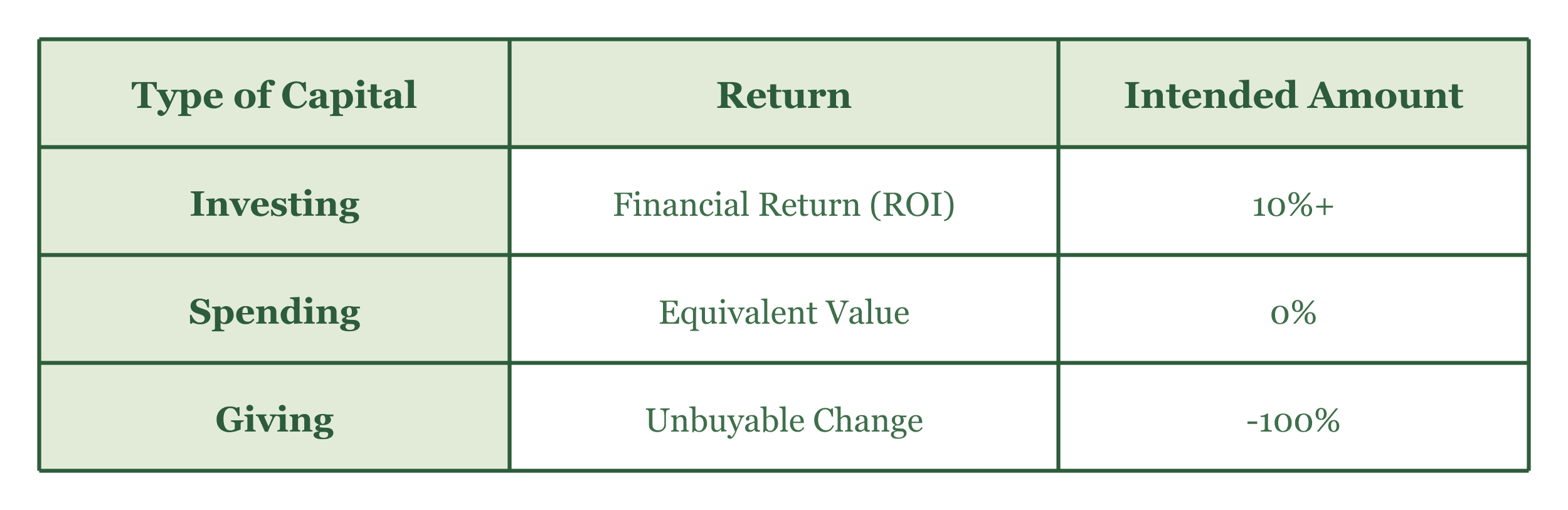

Giving capital is magic since its returns are measured in a different denominator.

For most key purchases, we think deeply and research widely. Why not give more focus on our giving?


This was week 1 of this month’s series “What is Wealth For?” Next week, we unlock the blueprint: "The Three Irrational Fears Keeping Your Wealth Frozen."